
Master the risk-based approach and take your lab operations to the next level.
Did you know that managing risks in your lab isn’t just about ticking boxes for compliance? It’s actually a powerful tool to avoid problems and continuously improve.
That’s why I recommend taking a close look at the updated versions of ISO/IEC 17025 and ISO 15189. These standards focus on anticipating problems and seizing opportunities—helping your lab become a safe, reliable space.
Today, we’ll explore how to manage risks in a practical, down-to-earth way, by identifying and evaluating them to build a culture of operational excellence.
What ISO/IEC 17025 and ISO 15189 Say About Risk Management?

Both ISO/IEC 17025 and ISO 15189 emphasize a risk-based approach. Labs are expected to:
- Plan and implement actions to address risks and opportunities. That means anticipating problems and spotting potential nonconformities so you can take preventive and corrective actions to keep things under control.
- Design processes while considering measurement uncertainty. Why? Because every error or deviation could affect the accuracy and credibility of your results.
- Foster a mindset of continuous improvement. Risk management isn’t just about avoiding failure—it’s about turning mistakes into improvement opportunities, strengthening the lab’s entire management system.
Bottom line: these standards don’t just ask you to avoid mistakes, they push you to turn every challenge into a competitive edge.
Why Is Risk Management So Important?

Let’s imagine your lab is like a race car. Would you want that car to break down halfway through a race because of some unexpected issue? Of course not.
Managing risks means more than having everything under control—it means being ready to anticipate and prevent failures before they happen. That boosts your quality, makes your clients feel more confident, and helps you move closer to the accreditation you’re aiming for.
Benefits of good risk management:
- Quality and reliability: Spot and fix issues before they grow into serious problems.
- Operational efficiency: Stay on top of existing risks and opportunities to improve continuously.
- Regulatory compliance: Meet ISO/IEC 17025 and other global standards with confidence.
Key Terms and Definitions

Before we get into the practical stuff, here are some basic terms you should know:
- Risk: Anything that makes it uncertain whether you’ll meet your objective.
- Risk level: A combination of the potential impact and likelihood of the risk happening.
- Risk assessment: Comparing the risk level to your lab’s acceptable criteria.
- Opportunity: A situation that, if managed well, can lead to gains or improvements in your lab.
Tools to Identify and Evaluate Risks

To manage risks effectively, you need tools that are practical and fit your lab’s context. Here are three must-have methods you can apply right away:
1- SWOT Analysis
The SWOT approach (Strengths, Weaknesses, Opportunities, and Threats) gives you a big-picture view of your lab:
- Strengths and Weaknesses: Evaluate your internal processes, staff skills, equipment status, and how well things are organized.
- Opportunities and Threats: Look at external factors like regulatory changes, market conditions, and your relationships with suppliers and clients.
This tool encourages collaborative brainstorming so you can prioritize improvement areas and define smart strategies.
Quick SWOT example for a clinical lab
Strength: Test results delivered in under 24 hours thanks to automation.
Opportunity: Partnering with private clinics that want to outsource lab services.
Weakness: Frequent sample traceability issues on the night shift.
Threat: New health regulations demanding tighter document control.
This helps focus efforts on improving traceability, leveraging partnerships, and tightening documentation to stay compliant.
2-Risk Matrix
This handy visual tool helps you classify and prioritize risks by assigning two key factors:
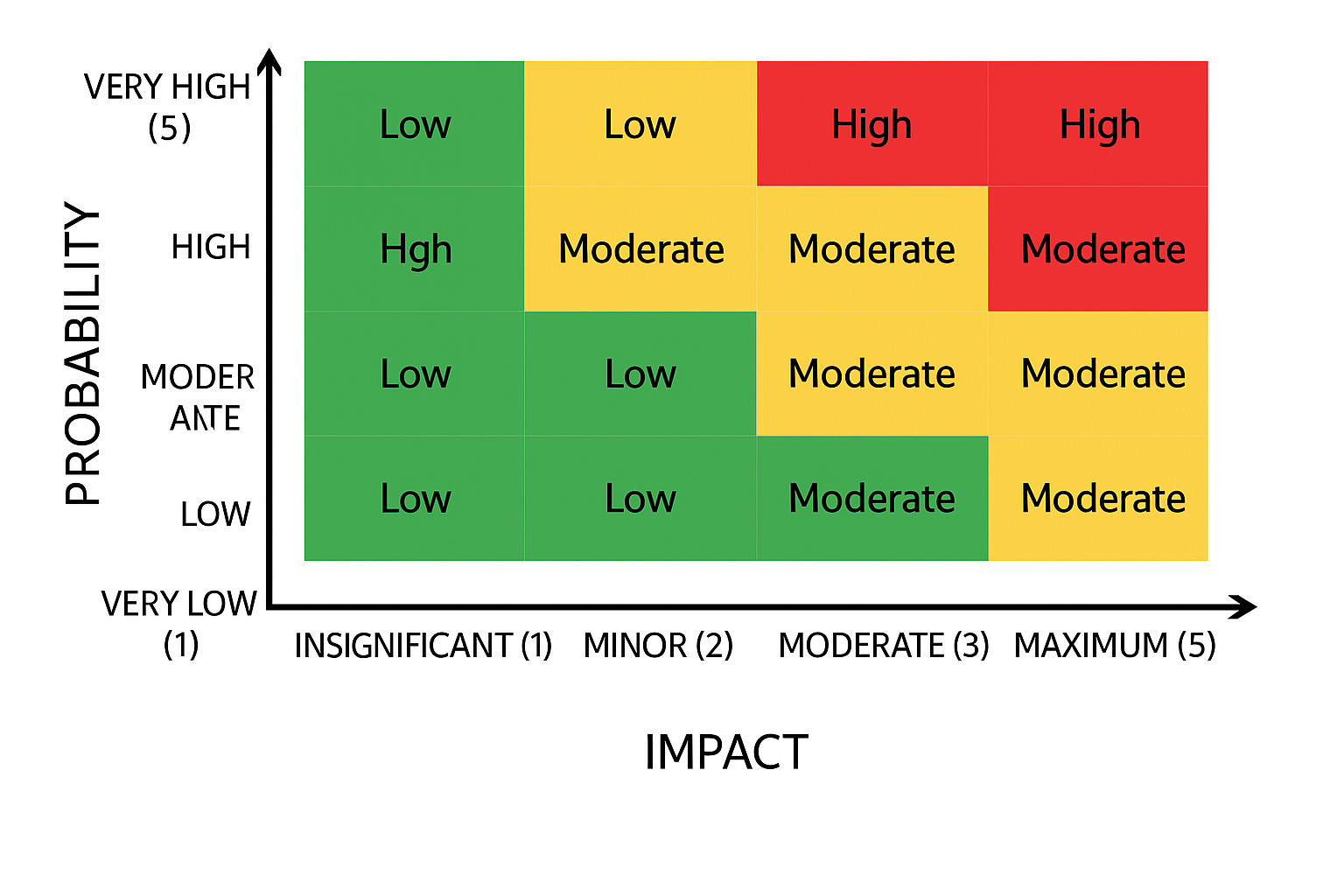
- Impact: How bad would it be if the risk happened? (low, moderate, high)
- Likelihood: How often is it likely to occur? (rare, occasional, frequent)
When you combine both, you get a clear risk map that shows you which issues need urgent action and which ones can be monitored. It’s perfect for decision-making and resource allocation.
Risk Matrix Example
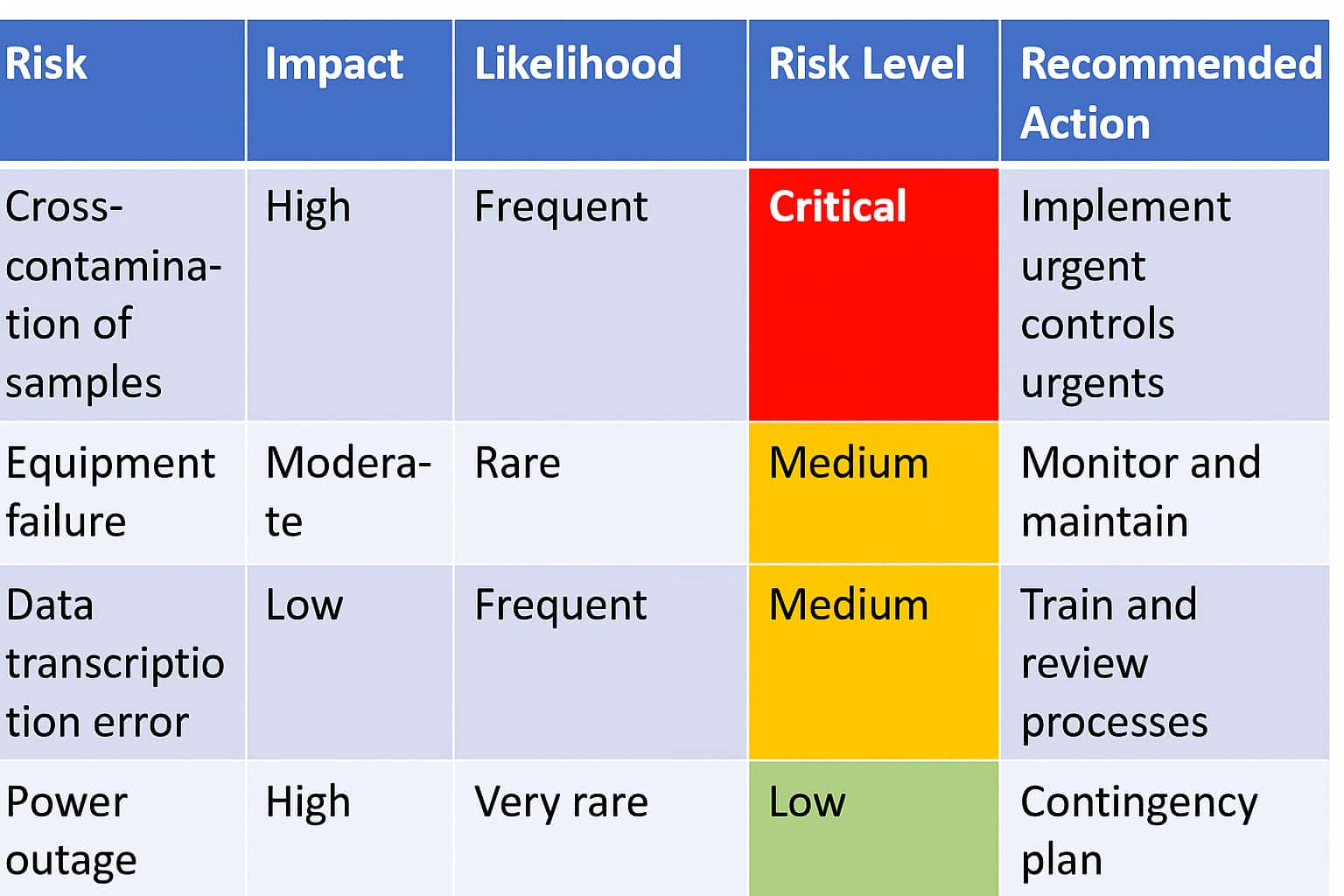
Critical risks like cross-contamination demand immediate action, while others like power outages can be managed with simple preventive measures.
3- Failure Mode and Effects Analysis (FMEA)
This is a proactive technique that digs into your processes to spot potential failures before they happen. It looks at:
- Severity: How serious would the outcome be?
- Probability: How likely is the failure to happen?
- Detection: How easily can you catch it before it causes damage?
You then calculate a Risk Priority Number (RPN) to focus on the most urgent issues and plan corrective or preventive actions.
FMEA Example – Blood Sample Processing in a Clinical Lab
Process analyzed: Centrifuging blood samples for biochemistry tests.
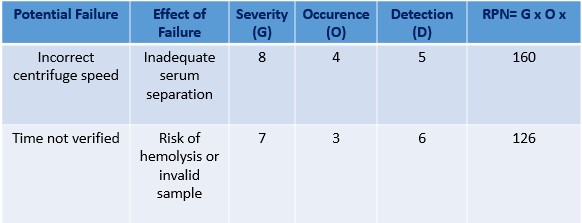
Recommended actions:
- Checklist for operators
- Mandatory training on critical equipment parameters
- Regular maintenance and timer calibration
Steps to Implement Risk Management in Your Lab
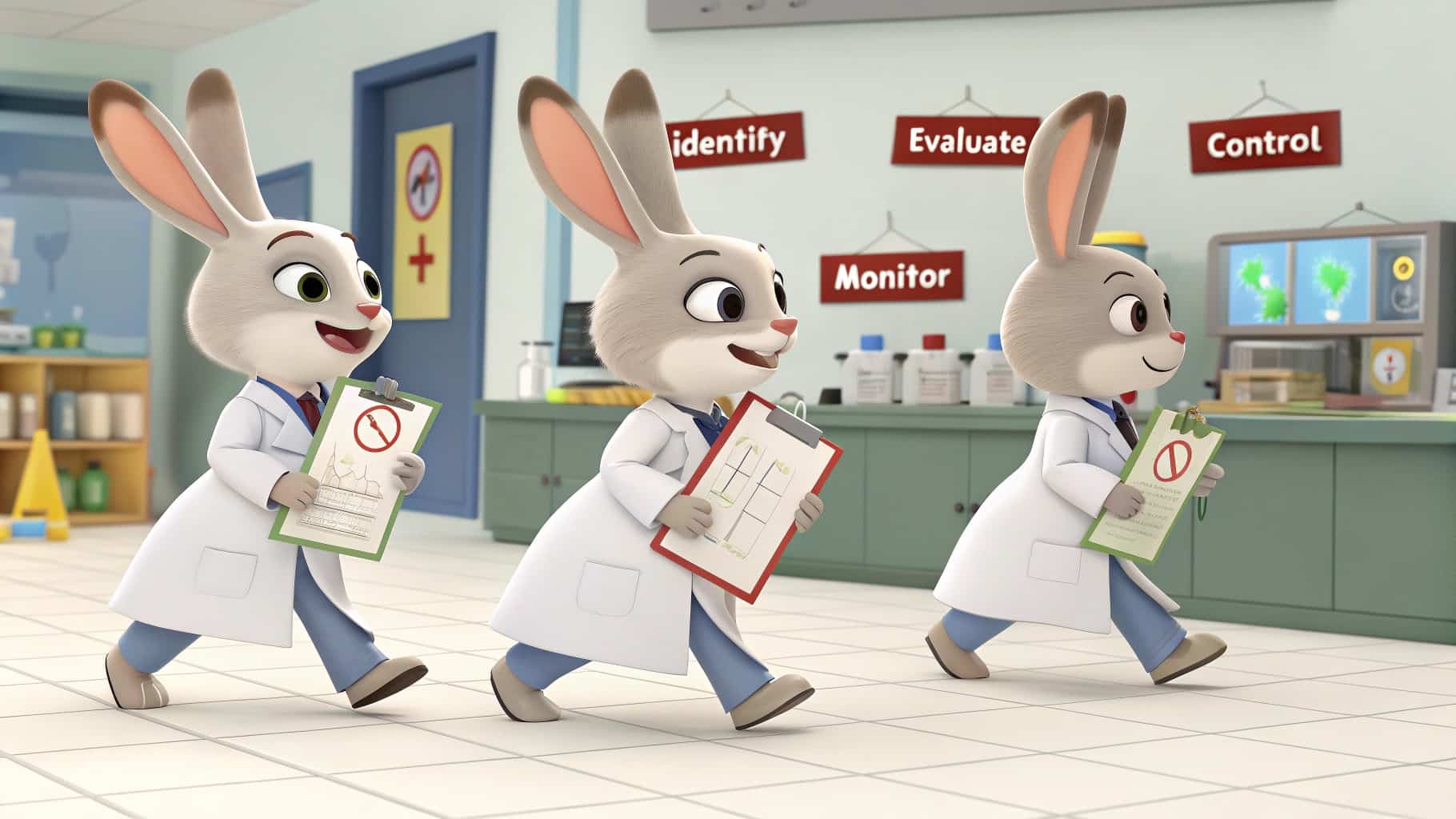
Here’s a step-by-step plan to get started:
1. Identify risks: Review all lab processes (pre-analytical, analytical, post-analytical) to find internal and external error sources.
2. Assess risks: Use the risk matrix or FMEA to score each risk by impact and likelihood. This tells you which ones need urgent attention.
3. Define and plan actions: Decide whether to avoid, reduce, share, or accept each risk. Define corrective and preventive measures, assign responsibilities, and set timelines and resources.
4. Implement and monitor: Put your plans into action, track performance with indicators, and adjust as needed through ongoing monitoring.
5. Review and update: Reassess your strategy when changes happen in the lab or the regulatory environment. Risk management is a dynamic process.
Key Benefits of Effective Risk Management

- Helps prevent problems by spotting them early—before they grow into full-blown crises.
- Builds credibility with clients and accreditation bodies by showing you’ve got a solid system in place.
- Drives continuous improvement through regular reviews that boost innovation and efficiency.
Conclusion
Implementing a risk management system based on ISO/IEC 17025 is a smart move that goes beyond compliance—it actively transforms your day-to-day lab operations.
It helps you identify, evaluate, and manage risks more systematically, improving quality, reducing errors, and enhancing safety across the board. In the end, it’s not just about avoiding setbacks—it’s about turning every challenge into an opportunity to grow and stand out in your industry.